

Knife Steel Types: The Difference Between 440C, D2 and S30V
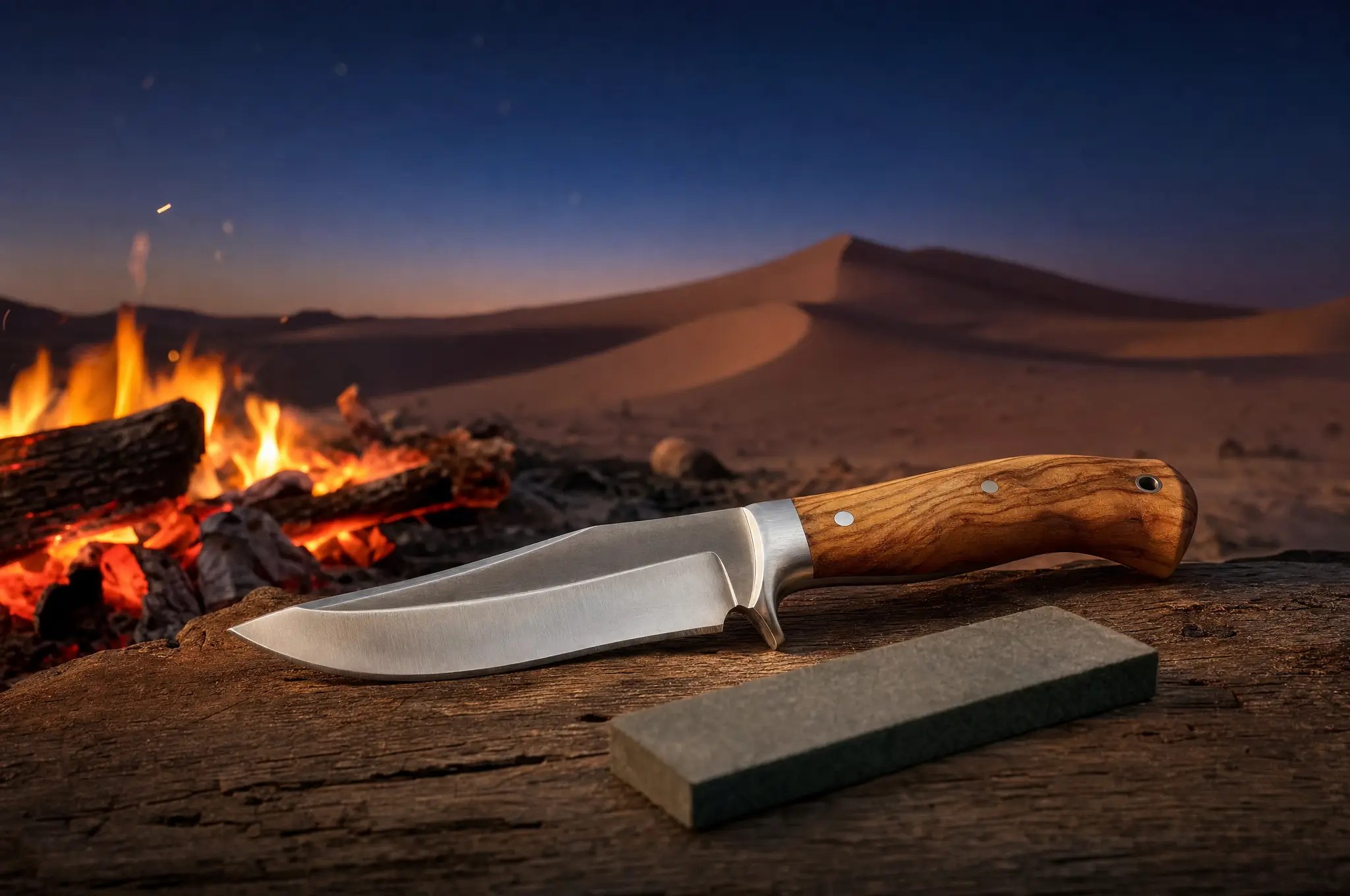
If you want the short answer: 440C is a balanced steel, it holds its edge well, it sharpens easily and it resists rust. D2 holds an edge far longer than that, but it is a semi-stainless and it will spot if you neglect it. S30V holds an edge longest of the three and its rust resistance is as good as 440C, but it asks more of you on the stone, and it does best with diamond or silicon carbide. As for 1.4116, that is the butchery and kitchen steel: softer, more patient with blood and washing, sharpened in seconds so you can carry on working.
What is edge retention, and what does Rockwell hardness mean?
Edge retention means how long the blade keeps cutting before you have to stop and sharpen it. Two things set it: the carbon in the steel, and the carbides that the chromium, vanadium and molybdenum form, hard grains inside the metal that work like teeth you cannot see, and they are what resists wear.
Rockwell (HRC) is a measure of how hard the metal is after heat treatment, and these are the numbers you will see:
- European butchery and kitchen knives: 54 to 56
- Stainless hunting knives: 58 to 60
- D2 and the powder steels: 60 to 62
The higher the number, the better the edge retention and the lower the toughness. A knife at 62 will hold its edge through a whole trip, but knock it against a thigh bone and the edge chips in small pieces that only come out on a stone. The trade here is hardness against toughness, and you do not get both.
What is the practical difference between 440C, D2 and S30V?
440C: carbon close to 1% and chromium at 17%, run at 58 to 60 Rockwell. A true stainless, it sharpens on any ordinary stone and the edge comes up nicely. You will find it in the Spanish Cudeman knives and in SCHRADE models. This is the one for somebody who wants a knife that will not give him grief.
D2: carbon at 1.5% and chromium at 12%, but most of that chromium is locked inside the carbides, so what is left in the metal is not enough to protect it, which is why it is called a semi-stainless. It runs at 60 to 62 and its chromium carbides are large, so it holds its edge through cutting and skinning far longer than 440C, though the edge comes off a little coarse and does not get to shaving sharp easily. Its real weakness is that it spots from blood and damp if you leave it an hour. COLD STEEL and SCHRADE both have D2 models.
S30V: this is a powder steel, pressed from powder rather than cast, with carbon at 1.45%, chromium at 14% and vanadium at 4%, run at 58 to 61. Its vanadium carbides are fine and very hard, so it gets both at once: high edge retention with excellent rust resistance and a fine edge. Spyderco is known for it. Sharpening is where it will work you a little if you do not have a diamond or silicon carbide stone.
Why is butchery and kitchen steel different from hunting knife steel?
A butcher's knife does a completely different job: it cuts meat and sinew, it meets bone and joint, it is washed with water and salt ten times a day, and the butcher stands there with the steel on his belt and passes the blade over it every couple of minutes. That is why the European steel 1.4116, technically X50CrMoV15, carries only half a percent of carbon at a hardness of 54 to 56. It is relatively soft, the edge comes back with two passes on a honing steel, it does not break on bone, and it takes being wet all day. That is the thinking behind F.DICK and ARCOS in butchery knives, and COLD STEEL uses German 4116 steel in its kitchen knives.
A hunting knife is the exact opposite: you are cleaning the animal out in the desert, skinning and jointing, with no steel on you and no time to stop, and you want a steel that will last until you finish. That is where 440C and S30V belong, and where a soft butchery steel will let you down halfway through the job. The two are kept apart on the site, in two sections: hunting knives, and butchery and kitchen knives.
Which steel holds up in Qatar's humidity and salt?
The word stainless does not mean it will not rust, it means it rusts more slowly. And Qatar's weather, high humidity with salt in the air, speeds everything up, while blood itself is salty and acidic and is the worst thing there is for a blade.
- 1.4116, 440C and S30V: comfortable, ordinary drying is enough
- D2: wants looking after, wipe it and dry it the moment you finish, not later
- Plain carbon, such as the OPINEL Carbone version in XC90 steel: it stains from the first animal and takes on a grey layer called a patina, which protects the blade rather than harming it, but leave it wet and forgotten and you get real rust
And if you want an OPINEL that will not give you trouble in the damp, take the Inox version made from Swedish 12C27 steel. One common mistake: storing the knife in its leather sheath. Leather traps moisture and the tanning chemicals eat the blade. The sheath is for carrying, not for storing.
When do you need a stone and when do you need a honing steel?
A honing steel, the rod on the butcher's belt, does not remove any metal at all. The edge rolls over slightly as you work, too little for you to feel, and the rod straightens it back, so use it often while you are working with a soft steel at 54 to 56.
A stone does remove metal and puts a new edge on, and its place is when the knife stops biting and starts sliding. The working angles: 20 degrees per side for a hunting knife and anything that meets bone, and 15 degrees for thin kitchen knives.
A honing steel is no use on D2 or S30V. They are hard enough that instead of straightening the edge it chips it. Even on a stone, the vanadium carbides in S30V are harder than the grains of an ordinary alumina stone, so it will slow you down. Diamond is easier and faster with these two, and silicon carbide will do the job.
How do you look after your knife after slaughtering?
- Wipe the blood off as you go, do not let it dry on the blade
- Wash with warm water and a mild soap, and dry it straight away with a dry cloth
- Pay attention to where the blade enters the handle and to the pins, because that is where rust starts, out of sight
- Put a light film of oil on the blade before storing it, and make it a food oil as long as the knife touches meat
- Never put it in the dishwasher: the heat and the salts in there ruin the edge and crack a wooden handle
- Do not cut on ceramic or marble, cut on wood or plastic
Which steel is right for you?
- You slaughter and cut up regularly: 1.4116 from F.DICK or ARCOS with a honing steel, and that is that
- You go out camping and clean your game on the dunes: 440C from Cudeman, or an S30V model from Spyderco if you want the longest edge retention
- A pocket knife that goes with you every day: the OPINEL Inox version, light and simple and it sharpens on any stone
- Your work involves bone and knocks: stay away from high hardness, the tougher steel is kinder to you than the harder one
And if you cannot tell them apart by eye, bring your knife to the shop in Souq Waqif, the Falcon Souq, and we will look at it on the stone, or message us on WhatsApp +974 5094 7142.