
How Do You Choose a Flashlight for the Desert? lumens Are Not the Whole Story
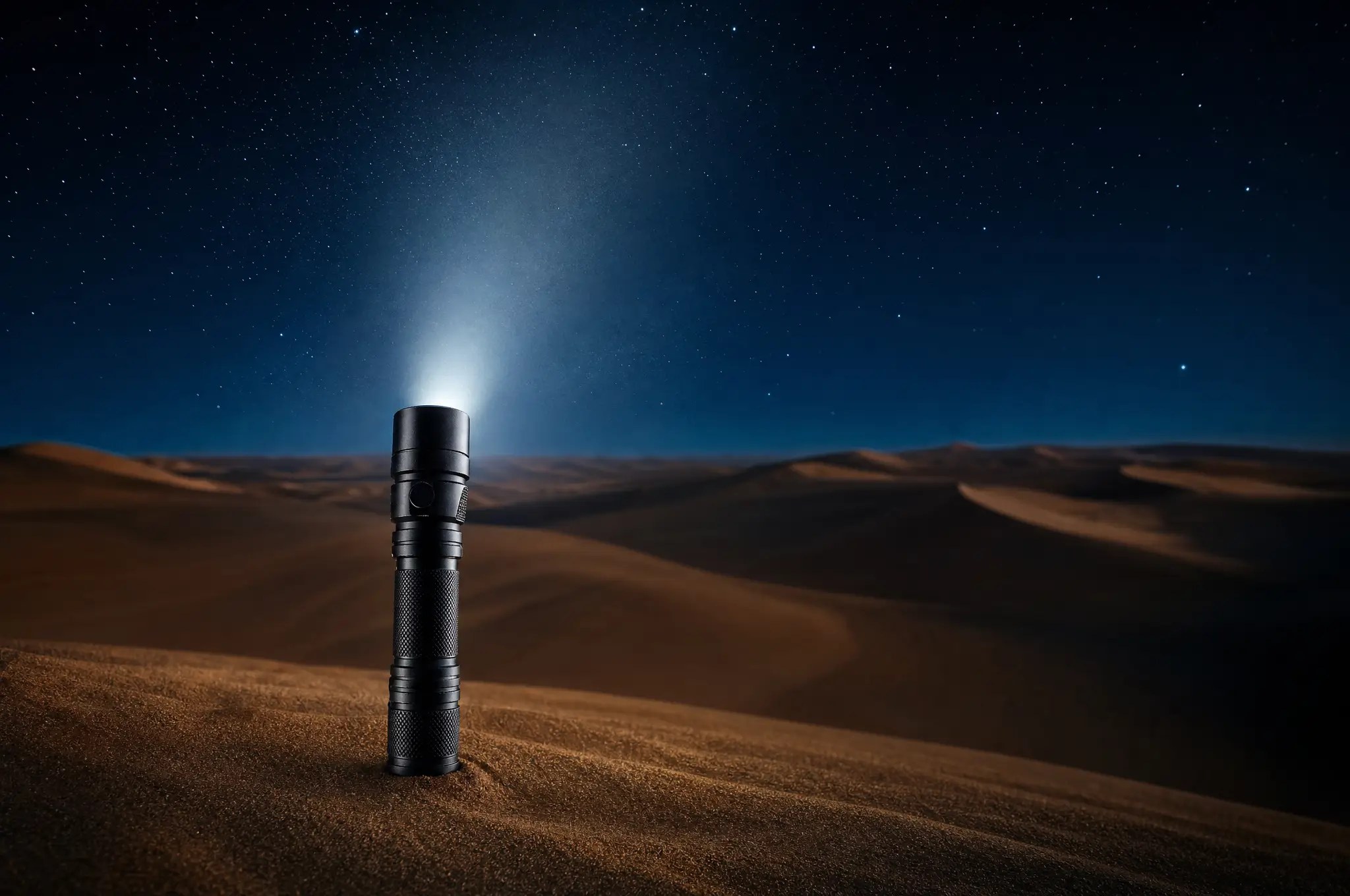
lumens measure the total light coming out of a flashlight; they do not measure how far the beam goes. What carries you out across the dunes is candela, the intensity of the light in the heart of the beam. So you have to read the two numbers together, and look at the beam type and the battery life under the ANSI FL1 standard before you pay.
Are lumens on their own enough to tell me a flashlight is strong?
No. lumens is a total: how much light leaves the flashlight in every direction. Candela is what tells you how concentrated that light is and how far it reaches. And you can do the sum yourself: beam distance in metres = 2 times the square root of the candela.
- A 2000 lumen flashlight with a wide beam and 6,000 cd reaches about 155 m.
- A 1200 lumen flashlight with a focused beam and 60,000 cd reaches about 490 m.
See how the one with fewer lumens reached three times further? So do not be taken in by the big number on the box on its own.
When do I need a focused beam and when do I need a wide one?
A focused beam comes out of a deep, smooth reflector and gives you a column of light that travels a long way in a narrow circle. That is what you need when you are looking for something far off: sweeping a dune or a wadi, following a bird that has gone out wide, or checking movement a few hundred metres away.
A wide beam comes out of a TIR lens or a textured reflector, and it lights a whole area close to you with no hard shadow. That is the tent and handwork mode: pitching, grilling, changing a tyre, walking over ground that is not level. Some flashlights put both in one body with two heads, and that is easier on you if you would rather not carry two.
Why will a flashlight not stay on its highest mode, and how long does it really last?
Because high output makes heat. The flashlight has thermal regulation that steps the output down one to three minutes after turbo, so the LED is not damaged and your hand is not burned. That is design, not a fault, and turbo is for moments anyway: light up the distance, check, come back down.
The number that matters to you on a trip is the medium and the low mode. A flashlight that gives you 300 lumens for eight hours is worth more to you than one that gives you 3000 lumens for two minutes. And watch one thing: the stated runtime is counted until the output falls to 10% of the first reading, so through the last part of that stated time the light is weak, not what it was at the start.
What does ANSI FL1 on the box mean?
It is a standard way of measuring, and its value is that you can compare two flashlights from two different companies with the same ruler instead of with advertising numbers. It measures six things:
- lumens: measured 30 seconds after switch-on, not in the first moment.
- Candela: peak intensity in the centre of the beam.
- Beam distance: the distance at which the light falls to a quarter of a lux, roughly the light of a full moon night.
- Runtime: until the output falls to 10% of the first reading.
- Impact resistance: in metres, from repeated drops onto a hard surface.
- Water resistance: by IPX code.
The companies that hold to the standard and print its numbers in full, like ACEBEAM, FENIX and NITECORE, you can compare with confidence. Anyone who prints lumens and says nothing about the rest, take their number with caution.
18650 or 21700? And how do I charge properly?
The numbers are sizes, not models: 18650 means 18 mm across and 65 mm long, 21700 means 21 mm and 70 mm. The larger one usually holds 4000 to 5000 mAh against 2600 to 3500 for the 18650, which means a longer runtime and a greater ability to pull current, but the flashlight gets heavier and thicker in the pocket.
On charging, watch three points. Most new flashlights have a USB-C port that charges the cell inside the flashlight, and that is easier on a trip with a power bank. Protected cells are about 3 to 5 mm longer because of the protection circuit, so sometimes they will not go into a tight flashlight. And a separate external charger, which XTAR is known for, lets you charge two cells and swap rather than sit and wait. Most important of all: do not leave lithium cells in the car under the summer sun, the heat eats their capacity.
IPX4, IPX7 and IP68: what is the difference in practice?
The code is simple: the first digit is for dust and the second for water, and the letter X means it was not tested. IPX4 takes splashing water from any direction and is enough for rain and spray. IPX7 takes one metre of immersion for 30 minutes. IPX8 goes deeper than a metre, to whatever the company states. And IP68 means it is sealed against dust as well.
Out in our desert the bigger problem is not the water, it is the dust and the sand. Fine dust gets into the O-rings and makes the head stick or the contact cut out at the moment you need it. So if the flashlight is going out on the dunes with you, look for an IP rating that covers dust, and clean the threads and the O-ring every so often and put a little silicone grease on them.
Handheld or headlamp?
A headlamp frees your hands, and that is reason enough on its own: pitching the tent, tying a knot, treating a bird, cleaning game. Take it wide in the beam and light in the hand, and preferably with a red mode, because red does not cost you your night vision and does not spook the birds.
A handheld gives you more reach and more power, you point it where you want, and you can pass it to somebody. The order I would put it in: a headlamp for close work, a handheld for distance, and a small one on your keys for emergencies, which is the slot RovyVon is known for.
Which type suits me: falconer, camper or night hunter?
- The falconer: a long-throw handheld to help you sweep the area while you are looking for the bird, with a wide, dim headlamp for the close work around it. And never put turbo in a bird's face.
- The camper: the priority is a wide beam and battery life, not high numbers. A headlamp, with something that runs on low for long hours.
- The night hunter: reach together with true colour. Flashlights with a high colour rendering index (CRI 90 and above) give you honest colour that lets you tell tracks, plants and blood apart, and the difference from cold blue light is obvious.
You will find lights from these brands in the handheld flashlights section, the chargers in electronics, and the rest of the camping kit in the camping supplies section. If you would like to talk it over before you decide, message us on WhatsApp +974 5094 7142, or come by in Souq Waqif, the Falcon Souq: Sunday to Thursday 8:00 to 13:00 and 16:00 to 22:00, Friday 16:00 to 22:00.