

Camping Kit Checklist: What You Actually Need, Not What Gets Sold
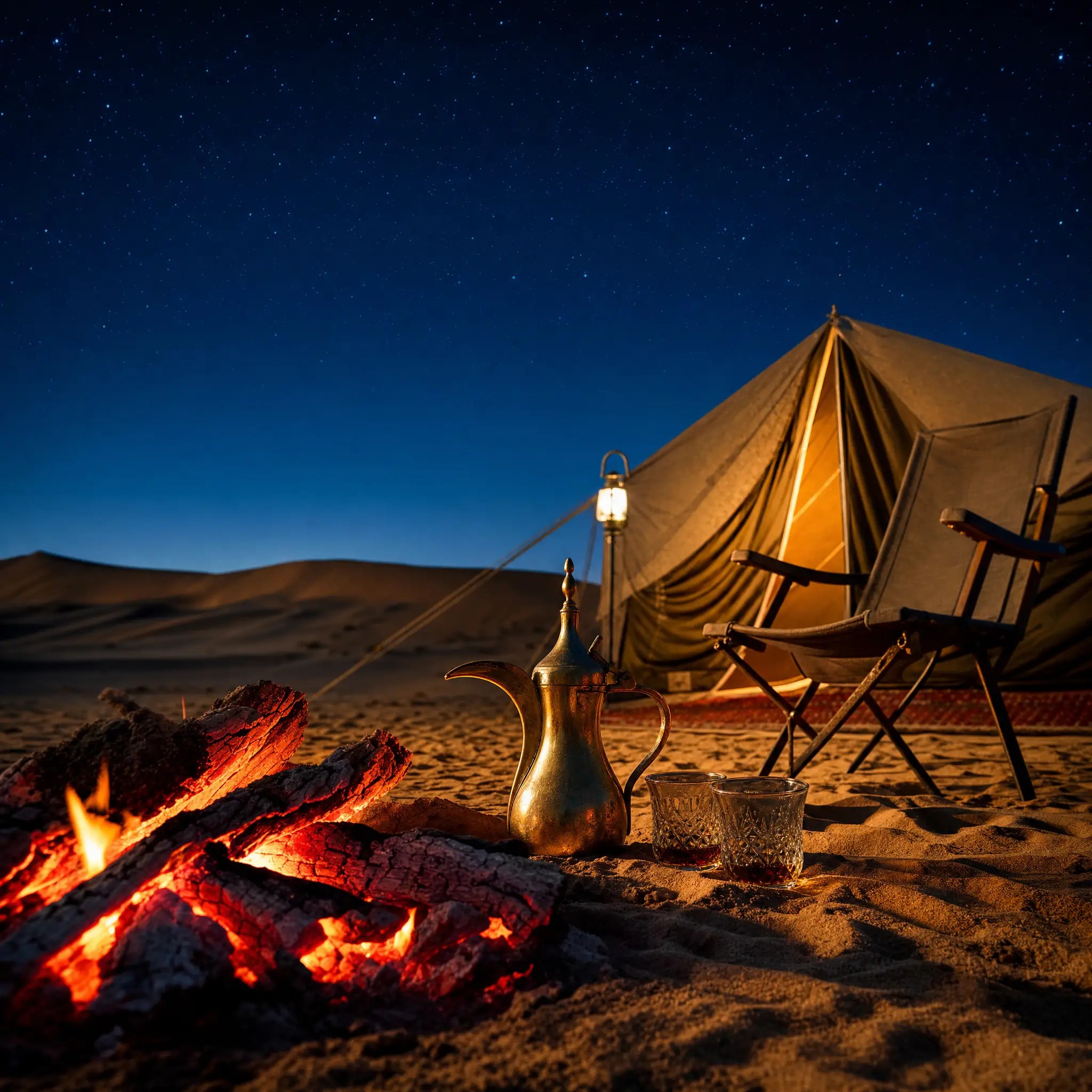
Kitting out for a night or two in the Qatari desert does not take half the car. Four things actually make the difference: sleep that keeps you warm, because a winter night out on the dunes is far colder than a night in Doha; light and power that do not lean on the car battery; water, cooking and the dallah; and a safety bag you only open if something happens. The rest is gear you buy and bring home from the desert clean, still unopened.
What do you need for sleeping and shelter on a desert night?
The ground is what pulls the warmth out of you, not the air, which is why insulation underneath matters more than the thickness of the blanket on top. And a small tent you can pitch on your own in the dark is worth more than a big one that needs three men.
- Insulation under where you sleep: a foam mat or an air mattress
- A heavy blanket or a sleeping bag; December and January nights out there are colder than the city forecast reads
- Spare pegs and a small hammer; a peg in soft sand comes out with the first gust
- A low chair; and if the boot is tight, take the chair and leave the table
How many flashlights do you actually need on a camping trip?
Three, and each one does a job the others cannot. A headlamp so you can work with your hands free, and 200 to 400 lumens on a wide beam is enough for cooking, pitching the tent and any close work. A camp light with a soft beam, which is what stops you pointing a flashlight into somebody's face all night. And a strong handheld for distance, for when you are looking for something far off or walking back to the car in the dark.
The common mistake is buying the highest lumen number and thinking it solves everything. Full power runs for a few minutes and then the flashlight steps its output down to control heat, and close in it blinds you rather than lights anything. More important than the number: that it runs on a rechargeable 18650 or 21700 cell with USB-C, and that it has a low mode that goes for long hours. You will find all three in the handheld flashlights section, and among the agencies ACEBEAM, FENIX and NITECORE, with RovyVon for the small one that goes on your keys.
How do you sort out power without leaning on the car battery?
In three layers, each one covering the one below it. A power bank for the phone and the flashlights: 20,000 mAh gives a modern phone close to three full charges, and that is two nights for two people. A power station if you have a small fridge or more than one thing to charge, and this one is rated in watt hours, not in mAh, with a station around 500 watt hours running the fridge a full night. And a car jump starter, which is no luxury out there, because if the battery dies on you far from anywhere, there is nobody to hand you a cable.
Two things about the jump starter that people forget: charge it before every trip, not after it, and do not leave it sitting in the boot under the summer sun for months, because heat kills lithium batteries fast. Power stations, power banks and battery chargers are all at Al Huwaila, and among the agencies XTAR and NITECORE cover chargers and cells.
How much water do you take, and how do you set up cooking and the dallah?
Start from four litres per person per day as a minimum in winter, and put it up if the weather is warm or you have children with you. That figure covers tea, coffee and cooking, not drinking alone, and take a spare gallon that stays in the car and is only opened in a tight spot.
For cooking, take a small gas burner and a lighter with matches beside it in a dry bag, a dallah, a kettle and cups that will not break, and one good knife instead of a full set. Stainless resists rust better and asks less of you: wash it, dry it and that is that. Carbon takes an edge more easily and comes off the stone sharper, but it wants drying and oiling after every use or it starts to spot and rust. From the agencies: OPINEL, SCHRADE, Cudeman and COLD STEEL for pocket and hunting knives, ARCOS and F.DICK if you want a serious butchery or kitchen knife, and Smith's for sharpeners. And take a small sharpener with you; a sharp knife is safer than a blunt one.
What do people forget every single time?
What gets forgotten is never the big stuff, nobody forgets the big stuff. It is the small thing that holds up everything after it when you do not have it:
- A spare lighter or matches; the one lighter always runs out or goes missing
- Spare batteries for the flashlight and an extra USB-C cable
- A car charger you have tested before the trip, not one bought and thrown in the glovebox
- A large rubbish bag: the desert goes home as clean as you found it
- A spare blanket that lives in the car, not in the tent
- A rope and a tow shackle; soft sand shows no mercy if you drive into it at road tyre pressure
What is on every kit list and has no reason to be there?
Most of what is sold as essential for a camping trip comes home unopened. For a night or two, you can do without these:
- A many-piece kitchen tool set; a knife and a large spoon do all of it
- A six-person tent for three people: harder to pitch and colder inside
- A big table that takes a quarter of the boot
- A high-magnification binocular with no tripod; too much magnification shakes in the hand and narrows the field of view, an 8x42 or a 10x42 will see you right, and any falconer knows a steady image matters more than the number
What has to be in the safety bag?
A bag you only open if something happens, and it stays in one place everybody knows: gauze and medical tape, antiseptic, burn cream, because gas and dallah burns are the most common injury on a camping trip, along with painkillers, gloves and a small flashlight that never gets pulled out of the bag.
And with it, things that live outside the bag but matter just as much: separate spare water, a full charge on the phone before you lose signal, and telling somebody at home where you are going and when you are back.
How do you put the list together at Al Huwaila?
Most of this list comes from two sections: camping supplies for bedding, tents and camp kit, and handheld flashlights for lighting and personal power. The shop holds 13 official agencies alongside goods imported under the Al Huwaila name, 48 brands on the shelves in all.
The shop is in Souq Waqif, the Falcon Souq, Doha. Hours are Sunday to Thursday, 8:00 to 13:00 and 16:00 to 22:00, Friday 16:00 to 22:00, closed Saturday. To ask about something before you come: WhatsApp +974 5094 7142 or call +974 4465 0041, and Instagram and Snapchat al_huwaila. Ordering online is by bank card through the SkipCash gateway, with delivery inside Qatar.