
What Does 8x42 Mean? Reading the Numbers on a Binocular
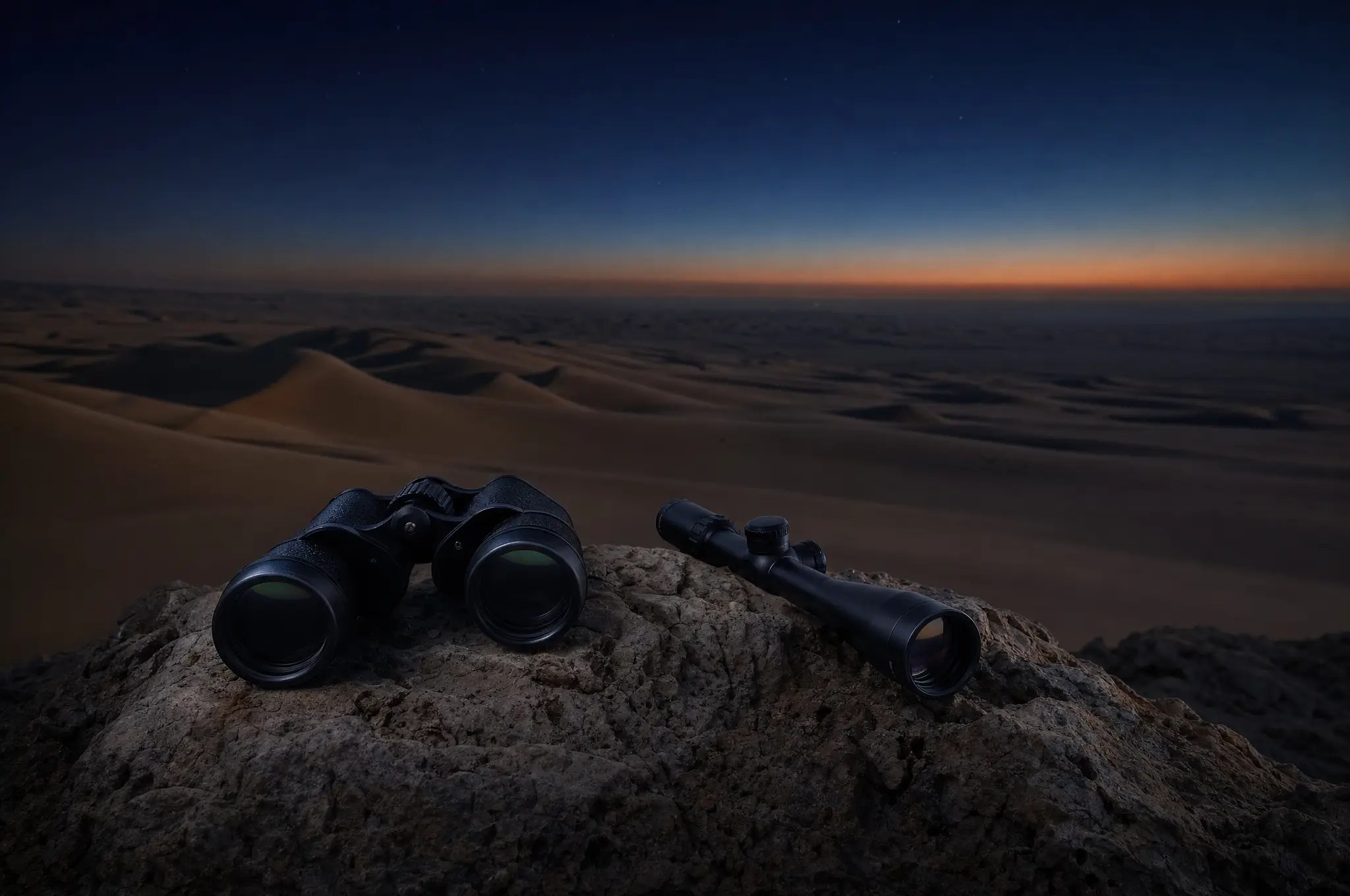
The first number is magnification, the second is the diameter of the front lens in millimetres. So 8x42 brings a thing eight times closer through a lens 42 mm across, and 10x50 brings it ten times closer through a 50 mm lens. Magnification pulls in the distance; the objective gathers the light and decides what you see at first light and last light. The two are tied together: push either one up and you pay for it in a shakier image, or in weight on your neck.
Does more magnification always mean I see better?
No, not necessarily. Magnification enlarges the image and it enlarges the shake in your hands by exactly the same amount. At 8x the natural tremor stays small enough to follow a bird standing up. At 10x it is obvious and your eyes tire if you stay on it. Above 12x nothing works freehand unless you brace on the car window or on your knee.
On top of that, high magnification narrows the picture and cuts the light reaching your eye.
Why does the objective lens diameter matter at dawn and dusk?
Because the front lens is the door the light comes in through, and its area grows with the square of the diameter, not with the diameter itself. A 50 mm lens gathers about 42% more light than a 42 mm, and a 42 mm about 72% more than a 32 mm. At midday you will not feel it, there is light to spare. But in the half hour before sunrise and the half hour after sunset, the best hours for birds, your eye sees it.
The price is weight. A 42 mm binocular usually runs 650 to 850 grams, a 50 mm comes close to a kilo or over it, and you feel that after it has hung on your neck from first light to mid morning.
What is exit pupil, and how do I work it out myself?
The exit pupil is the small disc of light that leaves the eyepiece and enters your eye, and the sum is easy: divide the objective diameter by the magnification.
- 8x42 gives 5.25 mm
- 10x50 gives 5 mm
- 10x42 gives 4.2 mm
- 8x32 gives 4 mm
- 10x25 gives 2.5 mm
In daylight your own pupil closes down to 2 or 3 mm, so any binocular is enough. In low light it opens to 6 or 7 mm while you are young, and that falls with age to around 5 mm or less. So anything with an exit pupil of 5 mm and up gives you a brighter image at the start and the end of the day. A large exit pupil also forgives you when your eye is not perfectly lined up and you are moving. And if you want one number that covers both, take the square root of the two multiplied: 8x42 comes out at 18.3 and 10x50 at 22.4. The higher it is, the better it copes with low light.
What is field of view, and why does it matter with a falcon?
Field of view is the width of the scene you see at a thousand metres, written either in metres or in degrees (one degree is roughly 17.5 metres at a thousand metres). An 8x42 usually gives you 120 to 140 metres, a 10x42 roughly 100 to 115.
The difference shows the moment you are following a falcon in the air: with a wide field you pick it up fast and stay with it easily, with a narrow one it slips out of the picture and you are hunting for it all over again. If you are working over the horizon from a fixed spot, though, a narrow field does you no harm.
What do the coatings do to the image?
Every glass surface with no coating loses about 4 to 5% of the light to reflection, and there are 10 to 16 surfaces inside a binocular. Uncoated, roughly half the light reaches you, and the rest comes back at you as glare and a white haze across the image. That is why the wording on the box matters:
- coated, a layer on at least one surface: the weakest of them.
- fully coated, one layer on every surface that meets air: a little better.
- multi-coated, several layers on at least one surface and less on the rest: middling.
- fully multi-coated, several layers on every surface: over 90% of the light gets through, and this is the one to look for.
In the hard light of the desert, ED glass earns its place too: it cuts the blue and yellow fringing along the edge of a dark bird against a bright sky.
Do I choose a roof prism or a porro?
Porro is the familiar dog-leg shape, the two objective lenses set wider apart than the eyepieces. Roof is two straight, slim tubes.
- Porro: a better sense of depth and dimension, and for the same money the image is usually cleaner, because the design is simpler and needs no extra coatings. Against it: bulky in a bag and hard to seal completely.
- Roof: slimmer and easier to carry, and easier to build sealed against water and dust. But its prism needs phase correction and a good reflective coating, and without them the image comes out less sharp and lower in contrast than a porro of the same level.
What exactly do "waterproof" and "fogproof" mean?
Two different things. Sealing means rubber O-rings that keep water and dust out, and it is often written IPX7, which means it takes one metre of water for 30 minutes, not that it is made for diving. Fogproof means the air inside has been drawn out and replaced with nitrogen or argon, a gas with no moisture in it, so no fog forms inside when you step out of an air-conditioned car into humid air.
The difference matters in our climate: fog on the outside you wipe off with a cloth, fog that gathers between the lenses has no cure. And the same sealing keeps out the fine dust of the desert.
Which size suits watching the dunes and following a falcon?
- 8x42: the all-round choice for a camping trip. An exit pupil of 5.25 mm, a wide field, steady in the hand, and the best thing there is for staying with a falcon in the air.
- 10x42 or 10x50: for standing and working over the dunes and the horizon from a fixed spot, or braced on the car window. The 10x50 is heavier but stronger in low light.
- 8x32: light for long walks, and it costs you some light at the end of the day.
- Pocket sizes, 8x25 and 10x25: fine in daylight and they live in the glovebox, weak at the start and the end of the night.
If you wear glasses, look for eye relief of 15 to 16 mm and up with eyecups that twist down, so you see the whole field. Before the first use, set the distance between the two tubes until the image becomes one single circle, then set the dioptre wheel (usually on the right eyepiece): close the right eye and focus with the left, then close the left and adjust the right with the dioptre. Most of the people who complain about a binocular never set it up in the first place.
What we have is in the binoculars section, and you can put your own eyes on it in the shop in Souq Waqif, the Falcon Souq, before you buy (Sunday to Thursday 8:00 to 13:00 and 16:00 to 22:00, Friday 16:00 to 22:00, closed Saturday). And if you are heading out at nightfall, take a flashlight from the handheld flashlights section with you, because a binocular gathers the light that is there, it does not make light of its own. For any question, WhatsApp +974 5094 7142.